
How Killingly Arrests Work
Killingly counted about 17,750 residents at the 2020 census. Local constables and resident state troopers split the policing. Dispatch runs through Troop D over in Danielson. That arrangement decides where the paperwork lands. State police arrests flow through the centralized Department of Emergency Services and Public Protection. Documents held by the town follow a municipal records route instead.
Processing might start with a constable, a resident trooper, or at Troop D itself. Officers can fingerprint a person, snap an intake image, log the charge, note the bond, and set a court date. One older CSP file lays out the sequence plainly: transport to Troop D, processing, bond, then a presentation at GA 11. Treat that as a single illustration rather than a fixed rule.
Windham County runs no county jail. It has no sheriff and no county corrections of its own. When a judge orders someone held, CT DOC assigns that person to a state facility. Someone released right after local processing may never show up in a DOC custody search at all.
GA 11 sits in Danielson, too. That blurs the lines between where an arrest happened, where processing took place, and which court hears the case first. A docket's court address reveals nothing about where someone is held. A Troop D reference does not create a permanent booking site. Keep three things straight: the police report, the docket, and the custody outcome. Each carries its own agency and its own date.
Where Killingly Busted Mugshots Appear
Killingly's official police page posts no arrest log. No daily blotter, no weekly roster, no booking-photo gallery on any schedule. Photos and records still exist, though. The fallback is a direct request, paired with court and custody checks. Each check answers a different question.
| Channel | Official status | Coverage |
|---|---|---|
| Killingly police and resident trooper | Official | Agency identity and local service; no complete public booking feed |
| DESPP Reports and Records | Official | Requested Troop D reports and existing images, subject to law |
| Judicial pending and conviction searches | Official | Court case and disposition; no mugshot function |
| CT DOC offender search | Official | State custody and sentence or release facts; text only |
| Villager and regional news | Independent media | Selected incidents or periodic text lists; photos vary |
| County aggregator pages | Unofficial | Incomplete leads that cannot confirm custody or outcome |
Read every empty result with care. A silent police page does not prove an arrest never happened. A blank DOC result does not rule out local processing followed by release. Court searches have their own blind spots, too. Timing lags, misspellings, confidentiality rules, erasure, and display limits can all hide things.
Busted in Killingly Lookup Steps
Any Killingly search goes smoother once you know two things. Which agency made the arrest, and where the person stands in custody. Danielson may surface in a headline, a dispatch note, or a court listing. The borough belongs to Killingly itself. Before ordering anything, match the agency named on the actual source document.
- Collect the full name, approximate date and place, incident number, and whether a constable, resident trooper, or another agency handled the event.
- Review the official Killingly police page for service details. For a Troop D report, use DESPP Reports and Records rather than asking for a nonexistent county booking card.
- Request the arrest report and any existing identification photograph as distinct records. Ask for electronic delivery and a fee estimate.
- Check the Connecticut Judicial Branch pending-case search by defendant, then match the docket and court instead of relying on name alone.
- Search CT DOC if the person may have been remanded or sentenced into state custody. Do not use the text-only locator as proof of every local arrest.
A custody locator usually goes quiet once someone is released. The trail does not end there. The arresting agency keeps its file. The court keeps its own record too. For a countywide map of how a police booking differs from a pending case or a DOC placement, see the Windham County busted mugshots search.
Note: A Danielson place-name does not change Killingly’s municipality; use the agency and docket identifiers shown on the official record.
Killingly Busted Records Through DESPP
Killingly resident-trooper cases leave a distinctive paper trail. The town's police forms page covers alarms and vacation patrols, not arrest records. For any Troop D matter, DESPP Reports and Records routes everything through the statewide GovQA system. A nonrefundable $16 search fee applies under CGS §29-10b. Invoicing and payment are handled online.
DESPP works requests in the order received. No completion date is promised. So make yours count. Include the arrested person's full name and date of birth if known. Add the arrest date, location, incident or case number, and Troop D as the agency. Spell out each item you want: the arrest report, the booking or intake sheet, any bond or release record, and an existing photo. Asking for an image does not guarantee one. DESPP will not manufacture a photo that was never taken.
DESPP Reports and Records
1111 Country Club Road
Middletown, CT 06457
860-685-8250
State Police records use the GovQA process.
Start with the state's own paperwork route. The official DESPP Reports and Records page lists the current request procedure, the fee schedule, and contact information for the Division of Emergency Services and Public Protection.
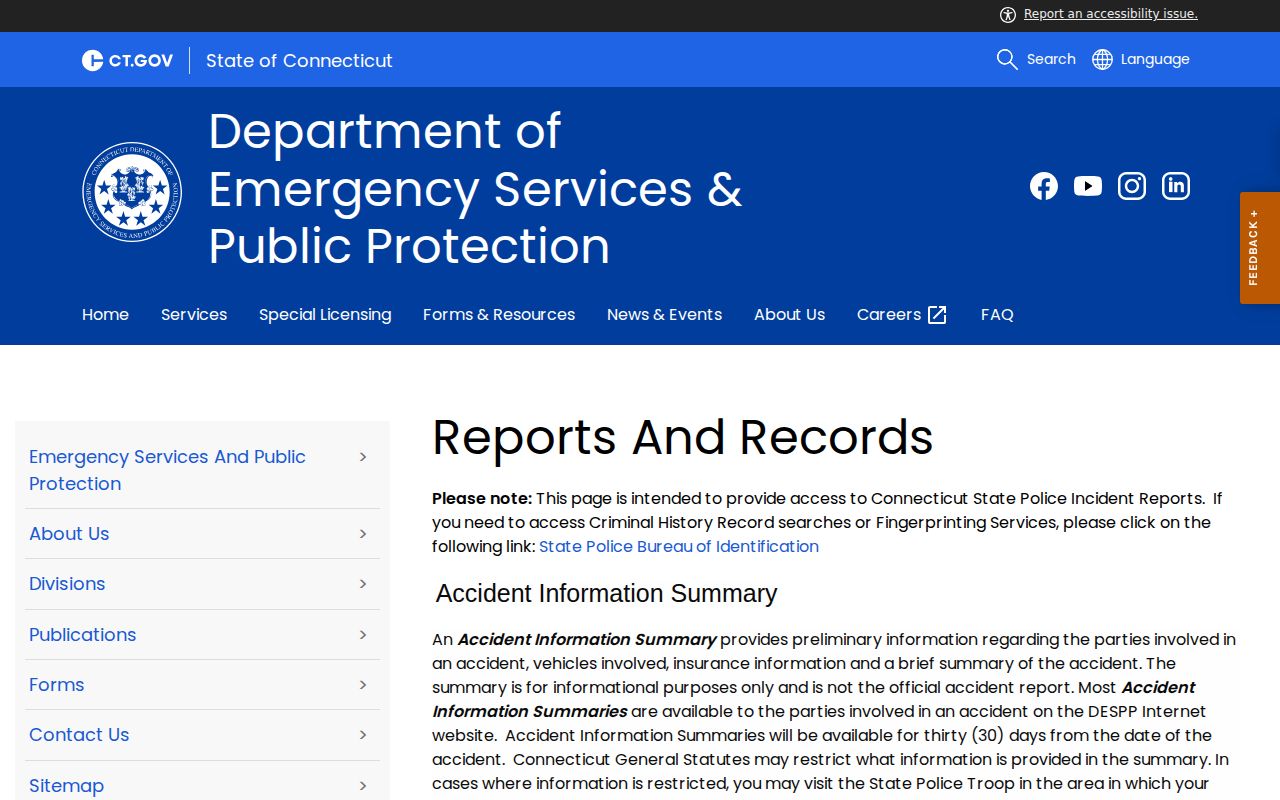
Keep expectations realistic about that page. It covers the formal record request process. Nothing more. No roster of Killingly arrestees lives there. There is no mugshot gallery of any kind.
Killingly Arrest Record Contacts
Start with the town itself. The Killingly Police and Resident Trooper page lays out the local setup and names the office to call. For anything that is not an emergency, dial 860-779-4900. The public safety administrator answers at 860-779-5300, extension 3907. Town Hall sits at 172 Main Street, Killingly, CT 06239. One quick call settles the first question: does the town hold the record, or does the Connecticut State Police?
If a Troop D officer made the arrest, DESPP is the agency to ask. Records kept by the town itself go through the municipal FOIA route instead. Connecticut law gives anyone the right to request nonexempt public records. A custodian may still redact protected details or cite a specific exemption. One wrinkle deserves attention. While a prosecution is pending, a request for records of an arrest or custody can also require notice to the proper state's attorney.
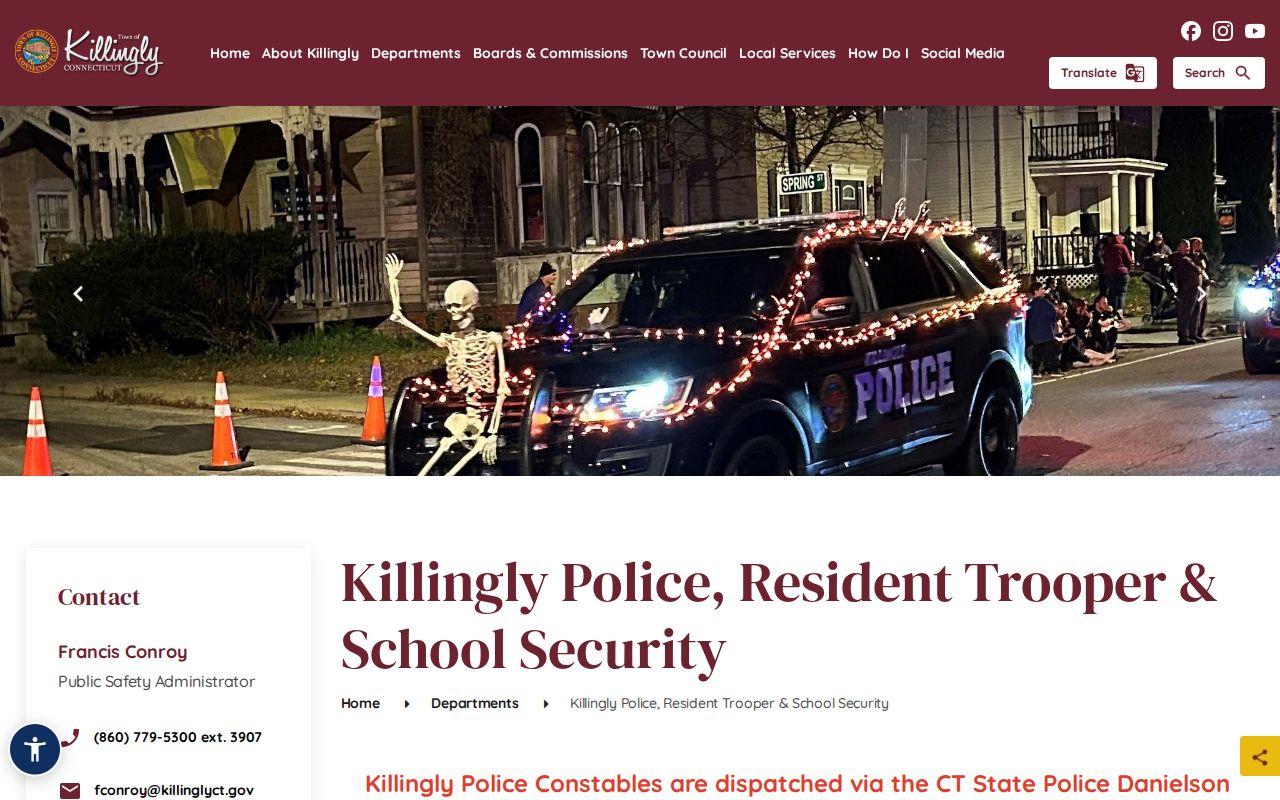
That page offers no named arrest log, roster, or photo feed. Skip it. Use the records route instead. One caution: a missing list does not mean no arrest documents exist.
No Killingly Booking Feed
Killingly has no verified same-day booking page. There is no multi-day named blotter either. CSP press releases touch only selected incidents across the state, so they can't stand in for a real Troop D feed. The town page gives no photo window, update schedule, or searchable archive of people released.
Follow the case itself instead. A constable or state-police record documents the local arrest. From there, the Judicial Branch criminal hub opens pending and conviction searches. The CT DOC offender search tracks anyone held in state correctional custody, pretrial or sentenced, though it posts no photo. The conviction interface may show a disposition later, within its limited online window.
- Bond
- Money or conditions tied to release and appearance.
- Remand
- A court order that keeps a person in custody.
- Nolle
- A prosecutor’s decision not to pursue a charge at that time, subject to Connecticut rules.
- Disposition
- The court result that gives the booking charge its later context.
Killingly Arrest News Coverage
Local news is another thread worth pulling. Killingly and Danielson incidents appear in the Killingly Villager and other Stonebridge Press editions, along with WINY, CT Insider, WFSB, NBC Connecticut's Killingly tag, and the Norwich Bulletin. Coverage is selective. Villager issues sometimes print arrest lists credited to police. Broadcasters tend to zero in on single events. Photos, when they run at all, may be missing, agency-supplied, or just scene shots.
A story can still hand you an agency name, an arrest date, a warrant reference, or a court location. Those details point toward the primary record. For a deeper look, the Windham County Arrest News page walks through moving from a report to police, court, and custody sources.
Recently Booked and Mugshots.com both maintain Windham County pages that might hold Killingly leads. Neither is official, and both can run stale or thin. Recently Booked's county view may show no live records despite its claimed rolling window, and Mugshots.com has no dependable local update schedule. Let official sources settle identity, current custody, and case outcome.